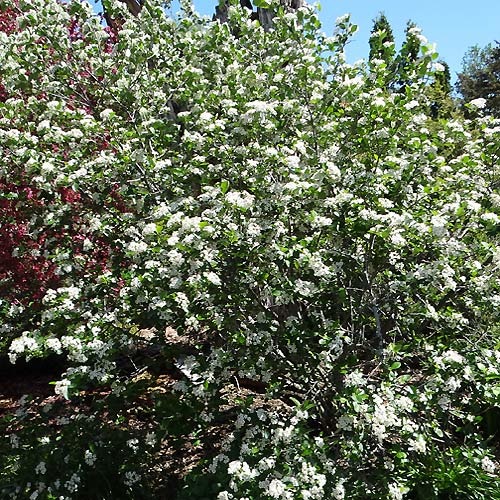
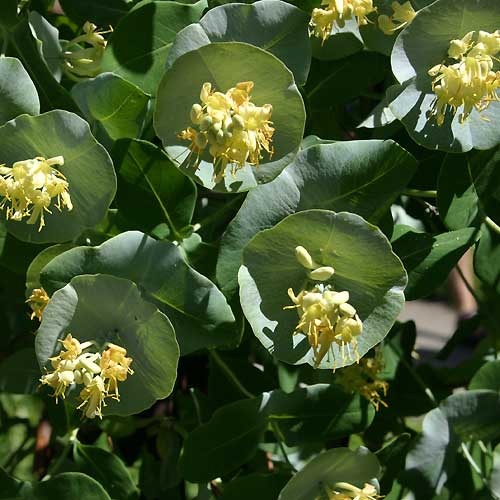
The Amelanchiers are at their peak right now in mid May here in Wisconsin. The shrubs are covered in blossoms! They surround you in blossoms -- it's like walking through clouds.
Amelanchiers in full bloom in May
There are many species and varieties of Amelanchier. Some are shrubs and some grow as small trees. As you can see, they're covered in white blossoms in the spring, which are followed by blue fruits that birds absolutely adore!
Blossoms cover these plants in May
It's hard to describe what it's like to be surrounded by these plants when they're in full bloom. It's like walking in the clouds.
Amelanchier grandiflora 'Princess Diana' in full bloom
Amelanchier canadensis on the left and Amelanchier grandiflora 'Autumn Brilliance' on the right
Amelanchier arborea - the most tree-like of the Amelanchiers
The blossoms aren't just beautiful. They're an important nectar source for insects in the spring.
Amelanchiers are commonly called Juneberries ('cause their fruit ripens in June), Serviceberries and Saskatoons. As noted above, birds go crazy for the fruit.
Amelanchiers are most often grown for its sweet fruit that is relished by birds. Over 42 species of birds eat the fruit! The fruit is also good for eating out of hand and for jellies. Native Americans used Amelanchier fruit in making Pemican, a staple of their diet.
Amelanchier fruit
Amelanchiers are very winter hardy and easy to grow in average garden soil from Zone 3/4 to 8. Most aren't bothered by disease and insects. And, they're native to North America!
They're also very showy in the fall with orange to red foliage.
We offer a wonderful shrub version of Amelanchier canadensis, called 'Regent'. See our Web site for information about this variety.
Here's a video of the Amelanchiers in bloom. Enjoy!
If there's one bulb to plant in your garden, it should be daffodils!
Daffodils!
Why? Rabbits and deer don't eat them. They are available in a variety of sizes, shapes and colors -- not just the common yellow trumpets, not that those aren't fabulous!!
Here's a few examples of the varieties we have in our gardens. We just adore these flowers and desperately need to see them in the spring!
Oh, and did we mention that daffodils come back reliably every year? And they multiply over time, so one bulb will grow to many bulbs? Oh yeah, and they make great cut flowers!! What's not to like?
We also adore Narcissus, which are in the Daffodil family. These have incredible fragrance. The common "paper whites" that we start indoors in the winter are Narcissus. They are similar to Daffodils in appearance, but the fragrance puts them in a whole different category. Be sure to plant some Narcisuss, too!
Wow, what a weird "spring" we're having this year! First, lots of snow in April. Lots! Take a look at this photo from April 23:
Big snowstorm on April 23, 2013
Well, that was crazy! Then it warmed up and we thought that spring had finally arrived. Here's my dog lounging on the last snowbank a few days later when the temps got into the 60s:
Then, the forecast called for more snow. What?! We couldn't believe it. And we were in the bullseye for getting the most snow. The day before it hit, the Orioles and Rose-breasted Grosbeaks returned! We were so worried about these tropical birds surviving the snow and cold. Here's what we woke up to on May 2, 2013 - 14 inches of snow!
14 inches of snow on May 2, 2013!
But, we heard the birds calling. It is spring and it is May after all! We made sure there was lots of seeds, suet and jelly out for the birds. And this is what we saw:
Oriole on snow-covered feeder in May
Here's a bird house with a snowcap
We're hoping for warm weather and sun tomorrow. It's in the forecast, at least! Let's hope for more normal weather the rest of this spring and summer.
Spring has finally arrived! The warm weather and the full moon brought in a lot of new migrating birds yesterday. They're all a few weeks later than usual, but we're so happy to see them.
Lots of birds migrate at night, especially during a full moon. The light of the moon guides their way. And they're protected from most predators at night.
We know they migrate at night because we see them and hear their songs in the morning, where they weren't there the day before. Plus, those who study bird migration have long-known about night-time migration of many birds by capturing birds in nets -- primarily at night -- for monitoring and banding.
After last night's full moon, we've heard and seen Brown Thrashers, Tree Swallows, White Throated Sparrows, White Crowned Sparrows, Chipping Sparrows and Bluebirds! These have joined the really early migrants that got caught in our late spring snowstorms in April: Red-winged Blackbirds, Fox Sparrows, Grackles and Robins.
Here's a photo of a Brown Thrasher taken last evening. It was trying to get suet out of the feeder. They're hungry after a long flight to get here.
Brown Thrasher
The male Brown Thrasher has a beautiful, long and variable song that doesn't seem to have a definitive beginning and end. It sounds a lot like a mockingbirds type of call. Some describe the call with the words, “plant a seed, plant a seed, bury it, bury it, cover it up, cover it up, let it grow, let it grow, pull it up, pull it up, eat it, eat it.” So, lots of people know it's time to plant their gardens when the hear the Brown Thrasher singing! I like that idea.
Here's a video we took last year of a male Brown Thrasher singing in our garden:
We're always so happy to hear the twittering of the Tree Swallows as they fly like dolphins in the sky around the pasture. Pairs of these acrobatic birds go from birdhouse to birdhouse as they establish their territory, renew mating bonds and claim a nestbox. They line their nests with feathers. If you're patient and lucky, sometimes you can offer them feathers by throwing them up in the air. They'll swoop in a grab the feather in their mouth and fly off. It's an amazing experience -- try it!
A Tree swallow on a nest box
Another beautiful bird that nests in birdhouses in the pasture is the beloved Bluebird. They have a sweet, faint call that reminds me of a Robin call. Actually, they're related! These birds really need our help, so providing nest boxes really makes a difference in their population. Be sure to keep the box protected from predators and monitor them throughout the summer. They'll raise two clutches of babies each summer here in Wisconsin.
Bluebird
We've also heard the first Chipping Sparrow. I got a glimpse of him this morning as he was announcing his arrival. They nest in our rose bushes and make a grass-lined nest a few feet off the ground. They'll also nest a few times each summer and raise batches of babies. We regularly check the nests for Cowbird eggs to ensure that the little "Chippies" don't end up raising a parasitic Cowbird instead of their own babies!
Chipping Sparrow
And one of our favorite migrants is the White Throated Sparrow. It stops at our gardens for about two weeks each spring and fall on its migration north and then south. I can't wait to hear their song, which sounds like "Old Man Peabody, Peabody, Peabody."
To learn more about bird migration and the birds we've highlighted on this posting, be sure to check out All About Birds at Cornell University. It's a great resource for those who want to learn more about their backyard birds!
Winter just doesn't want to let go of it's grip on us this year. We got another snowstorm last night and today it looks like January instead of April!
Here's what our gardens looked like last year on April 2, 2012:
We've had four weekends in a row with snowstorms in late March and through April. Spring just can't make any headway here in Wisconsin.
So, what might be causing this "stuck" weather pattern that we're in? One theory for this is called "arctic amplification."
I first heard about this from meteorologist, Paul Huttner in his blog. His quick explanation of arctic amplification is that it works like this:
A warmer Arctic reduces temp contrasts between the poles and tropics.
Less temps contrast = slower jet streams.
Deeper, more "amplified "Rossby Waves" (that change weather
patterns) get stuck in place for longer periods.
Stuck jet streams = fewer changes and more persistent droughts, floods,
cold outbreaks, etc.
Next time you watch the weather report, take a look at the maps showing jet streams and fronts. They're always in curvy, wavy lines. So, the longer and wider the curves of the jet streams, the slower they move, apparently.
As gardeners, we set our gardening patterns on the weather patterns for planting, pruning, harvesting and enjoying. Who knows, maybe this arctic amplification theory is right? Or maybe it's just one of many reasons to explain the late spring we're having. Either way, I can't wait to see the daffodils again!
If you'd like to learn more about arctic amplification, here's a really good and fairly easy to understand video by Jennifer Francis of Rutgers University.